


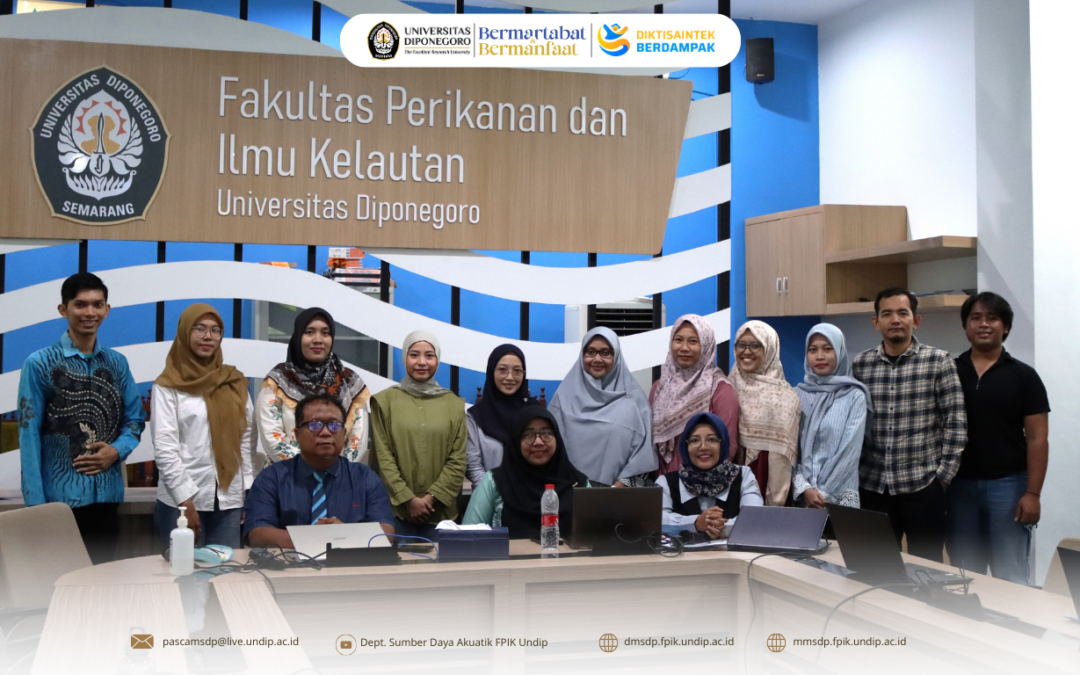
Scientific publication is crucial for researchers to communicate their research outputs globally. It is also a requirement for graduate students to graduate at both the Master’s and Doctoral levels. Dr. Lia Kusmita, S.Si., M.Si., Head of the Institute for Research and Community Service (LPPM) STIFAR Yayasan Pharmasi Semarang, shared techniques and strategies for preparing manuscripts for publication in reputable journals.
The guest lecture, held on October 27, 2025, took place on the 3rd Floor of the Dean’s Office, Faculty of Fisheries and Marine Sciences (FPIK), Diponegoro University. It was attended by graduate students from the Master’s and Doctoral programs in Aquatic Resources Management. Several lecturers participated in the event, including Dr. Putut Har Riyadi, S.Pi., M.Si., Vice Dean II, FPIK; and Dr. Aninditia Sabdaningsih, S.Si., M.Si. as Head of the Postgraduate Program in Aquatic Resources Management, Department of Aquatic Resources, FPIK; and Dr. Diah Ayuningrum, S.Pd., M.Si. as Secretary of the Undergraduate Program in Aquatic Resources Management, Department of Aquatic Resources, FPIK.
Dr. Lia explained that knowledge that isn’t shared will be lost, so it needs to be written down to keep it alive. She also emphasized that writing requires effort, time, and a goal for completion to produce good work. She also explained the various types of scientific articles and the stages involved in publishing them. Ultimately, the publication process requires courage and perseverance if not yet accepted into a journal. The students were enthusiastic and engaged in active discussions, as exemplified by several doctoral students, including Burhanuddin Ihsan, Astrid Fauzia Dewinta, and Dwi Sulistiyono, who asked about technical issues and their experiences in publishing scientific papers.
This guest lecture was an implementation of the collaboration agreement signed by FPIK and STIFAR in 2024. The concrete manifestation of this collaboration in 2025 will not only take the form of training, but also joint article writing and manuscript mentoring on several titles prepared by the students. This activity certainly greatly supports Undip’s big goal of achieving a QS WUR ranking in the world’s top 500.